logo
Batch - 03

Advanced Certificate Programme in Machine Learning, Gen AI & LLMs for Business Applications Programme offered by IITM Pravartak Technology Innovation Hub of IIT Madras

line
  • Duration: 10-11 Months
  • Work Experience: Min. 1 Year of Experience

Download Brochure

Programme Overview

The Advanced Certificate Programme in Machine Learning, Generative AI & LLMs for Business Applications by IITM Pravartak, Technology Innovation Hub of IIT Madras, equips professionals with the core knowledge and hands-on skills required to apply AI and Generative AI in real-world business scenarios.

The programme builds from AI and machine learning fundamentals to advanced concepts such as deep learning, generative models, and large language models (LLMs). Participants gain practical exposure through hands-on projects, including GPT-based text generation, and explore applications across NLP, chatbots, image and speech processing.

Designed with a strong industry focus, the programme enables learners to leverage AI-driven insights and innovation while staying ahead of emerging trends in Generative AI and Machine Learning.

Programme Highlights

logo
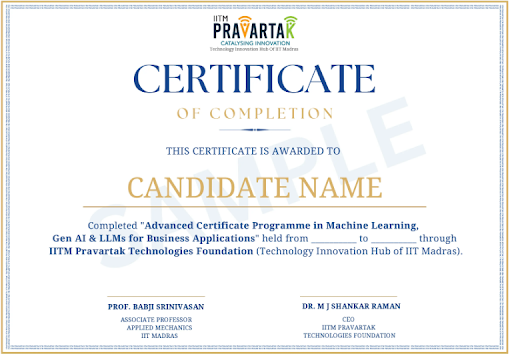
Certificate of Completion by IITM Pravartak
logo
Live Online Teaching by the Faculty of IIT Madras
logo
Industry-led Pedagogy
logo
2 Days of Campus Immersion (optional)
logo
Flexibility in learning: online classes on weekends
logo
Access to Extensive Reference Materials for Continuous Learning
logo
Dedicated Programming Sessions to Enhance Practical Skills
  • Understanding of concepts of AI, Machine Learning, and emerging technologies.
  • Apply theoretical knowledge through hands-on projects.
  • Acquire specialised knowledge in generative AI, including GANs, VAEs, large language models, and reinforcement learning for generative tasks.
  • Explore diverse applications of AI in image processing, speech processing, text processing, chatbots, and natural language processing (NLP).
  • Online Sessions
  • Tutorial sessions
  • Live Immersion classes
  • Mini Quizzes
  • Project
  • Programming Sessions
  • Reference materials (text, videos, documents and research articles)

Programme Curriculum

Module 1: Fundamentals of Machine Learning with Practical Applications

Overview of Machine Learning Concepts

  • Supervised, Unsupervised, and Reinforcement Learning
  • Common Machine Learning Algorithms

Machine Learning Workflow

  • Problem Definition and Data Collection
  • Data Preprocessing and Feature Engineering
  • Model Selection and Training
  • Model Evaluation and Tuning

Introduction to Scikit-Learn

  • Data Preprocessing with Scikit-Learn
  • Implementing Classification and Regression Models
  • Model Evaluation Metrics and Cross-Validation

Advanced Machine Learning Techniques

  • Ensemble Methods: Random Forests, Gradient Boosting
  • Dimensionality Reduction: PCA, LDA
  • Clustering Techniques: K-Means, Hierarchical Clustering
  • Predictive Modeling with Real-World Datasets
  • Implementing Recommendation Systems
  • Time Series Forecasting with Machine Learning Models
  • Problem Statement and Data Exploration
  • Model Development and Evaluation
  • Optimization and Final Presentation

Module 2: Deep Learning Technologies with Practical Python Tools and Frameworks

Fundamentals of Neural Networks

  • Neurons, Layers, and Activation Functions
  • Loss Functions and Optimization

Deep Learning Architectures

  • Convolutional Neural Networks (CNNs)
  • Recurrent Neural Networks (RNNs)
  • Advanced Architectures: LSTMs, GRUs, Attention Mechanisms

Introduction to TensorFlow and Keras

  • Building Neural Networks with Keras
  • Training and Evaluating Deep Learning Models
  • Visualizing Model Performance

PyTorch for Deep Learning

  • Understanding Tensors and Autograd
  • Implementing CNNs and RNNs with PyTorch
  • Transfer Learning and Fine-Tuning Pre-Trained Models
  • Image Classification and Object Detection with CNNs
  • Sequence Modeling for NLP Tasks with RNNs
  • Advanced Topics: GANs, Autoencoders, and Attention Models
  • Problem Statement and Data Preparation
  • Model Development and Tuning
  • Final Model Evaluation and Presentation

Module 3: Generative AI Technologies with Python Tools and Frameworks

Overview of Generative Models

  • GANs, VAEs, and Diffusion Models
  • Applications of Generative AI

Generative Adversarial Networks (GANs)

  • GAN Architecture and Training Process
  • Implementing GANs with TensorFlow/PyTorch
  • Applications of GANs: Image Synthesis, Style Transfer

Understanding VAEs

  • Encoder-Decoder Architecture
  • Latent Space Representation and Sampling

Diffusion Models for Generative AI

  • Basics of Diffusion Processes
  • Implementing Diffusion Models in Python
  • Creative AI: Art and Music Generation
  • Data Augmentation with Generative Models
  • Ethical Considerations in Generative AI
  • Project Setup and Data Collection
  • Model Development and Fine-Tuning
  • Final Model Deployment and Presentation

Module 4: Large Language Models (LLMs), Fine-Tuning, Agents, and RAG

  • Evolution of LLMs: From GPT to GPT-4 and Beyond
  • Transformer Architecture and Attention Mechanism
  • Pre-trained vs. Fine-Tuned LLMs: Differences and Use Cases
  • Data Preparation for Fine-Tuning
  • Fine-Tuning LLMs with Hugging Face Transformers
  • Evaluating and Optimizing Fine-Tuned Models
  • Introduction to LangChain for Building AI Agents
  • Creating Custom Chains and Workflow Automation
  • Integrating LLMs with External APIs
  • Understanding RAG Concepts and Architecture
  • Implementing RAG with Hugging Face Transformers
  • Practical Applications of RAG in QA and Search Systems
  • Project Setup and Data Collection
  • Model Development and Fine-Tuning
  • Final Model Evaluation and Presentation

Module 5: Applications of LLMs with Text, Video, Image, and Audio

  • Automated Content Creation and Summarization
  • Building Conversational Agents and Chatbots
  • Sentiment Analysis and Text Classification
  • Text-to-Image Generation with DALL-E and CLIP
  • Video Synthesis and Editing with Generative Models
  • Combining LLMs with Computer Vision Tasks
  • Text-to-Speech (TTS) Systems with LLMs
  • Music and Sound Generation
  • Voice Cloning and Audio Enhancement
  • Project Proposal and Planning
  • Data Collection and Model Development
  • Final Integration and Presentation

Module 6: Building Integrated Generative AI Applications

  • Integrating Text, Image, and Audio Models
  • Case Studies: AI Art, Music Videos, Virtual Worldst
  • Developing Cross-Modal Retrieval Systems
  • Fine-Tuning LLMs for Multimodal Tasks
  • Building End-to-End Multimodal Pipelines
  • Deployment Strategies for Multimodal Applications
  • Project Planning and Data Collection
  • Model Integration and Workflow Design
  • Final Testing, Optimization, and Presentation

Module 7: Module 7 Productionizing the Applications – End-to-End Pipeline

  • Overview of MLOps and Best Practices
  • Setting Up CI/CD Pipelines for AI Applications
  • Monitoring and Maintaining AI Models in Production
  • Model Deployment with TensorFlow Serving and TorchServe
  • Scaling Applications with Docker and Kubernetes
Note: *subject to modifications at a later stage if required, as per the discretion of the faculty.

Cutting-Edge Tools and Techniques

Machine Learning Packages

Scikit- learn, Pytorch, Tensorflow

Gen AI Packages

Hugging Face Hub, Langchain

Models

BERT, Transformer, along with several conventional models

Eligibility Criteria

  • Graduate/4-year Engineering/Tech Degree /B.Sc/ BCA/ M.Sc/ MCA from a recognized university (UGC/AICTE/DEC/AIU/State Government/recognized international universities).
  • A minimum of 50% is required for qualification.
  • Industry Targeting (Preference): IT, Tech, Software, Engineering Research, Business Analytics, etc.
  • Professionals from a tech background must have a minimum of 1 year of work experience.

What Your Career Will Look

Upon completion of this program, participants will be well-equipped to pursue diverse career opportunities in the rapidly expanding field of AI and ML. Potential career paths include

  • AI/Machine Learning Engineer
  • Data Scientist
  • AI Researcher
  • AI Consultant

Fee Structure

Application Fee

(non-refundable)*

INR 1,500/- + GST

Programme Fee

INR 1,30,000/- + GST

Instalment I

Amount

INR 60,000/- + GST

As mentioned in the offer letter

Instalment II

Amount

INR 40,000/- + GST

Due on 5th July 2026

Instalment III

Amount

INR 30,000/- + GST

Due on 5th September 2026

EASY EMI OPTIONS AVAILABLE*

Faculty & Industry Expert

image

Prof. Babji Srinivasan

Director and Programme Coordinator

Associate Professor, Applied Mechanics and Biomedical Engineering, IIT Madras

image

Dr. Ramji Srinivasan

( Faculty )

Director, Bit2Qubit Inc; Former
Qualcomm Employee;
Consultant

FAQs

This programme is designed to equip professionals with a strong foundation in Machine Learning, Generative AI, and Large Language Models (LLMs), with a focus on real-world business applications and hands-on learning.

The programme is ideal for:

  • Working professionals and managers
  • Engineers and developers
  • Data analysts and data scientists
  • Technology leaders and consultants
  • Professionals transitioning into AI & GenAI roles

The curriculum covers:

  • AI & Machine Learning fundamentals
  • Deep Learning concepts
  • Generative AI models (GANs, VAEs)
  • LLMs & GPT-based applications
  • NLP, chatbots, image & speech processing
  • Emerging AI & ML trends
Yes. The programme includes practical assignments and hands-on projects, including text generation using GPT models, enabling participants to apply concepts to real business use cases.
The programme is delivered through structured online learning, combining expert-led sessions, practical exercises, and applied projects for maximum flexibility.
Basic knowledge of programming or data concepts is helpful, but the programme starts with foundational AI and ML concepts, making it suitable for both beginners and professionals with prior exposure.
Participants who successfully meet the evaluation criteria and satisfy the requisite attendance criteria will be awarded a 'Certification of Completion' - Advanced Certificate Programme in Machine Learning, Gen AI & LLMs for Business Applications.

Graduates can pursue roles such as:

  • AI / Machine Learning Engineer
  • Data Scientist
  • Generative AI / LLM Engineer
  • AI Researcher
  • AI Consultant
The programme helps professionals build future-ready AI capabilities, apply AI to business problems, and strengthen their profile with a recognised IIT Madras–backed certification.
Yes. The programme is designed with a business application focus, enabling professionals to understand how AI and Generative AI can drive innovation, efficiency, and competitive advantage.

Programme Certification

certifcate
  • Participants who successfully meet the evaluation criteria and satisfy the requisite attendance criteria will be awarded a 'Certification of Completion' - Advanced Certificate Programme in Machine Learning, Gen AI & LLMs for Business Applications.